Devformance Goals: Combining Development and Performance
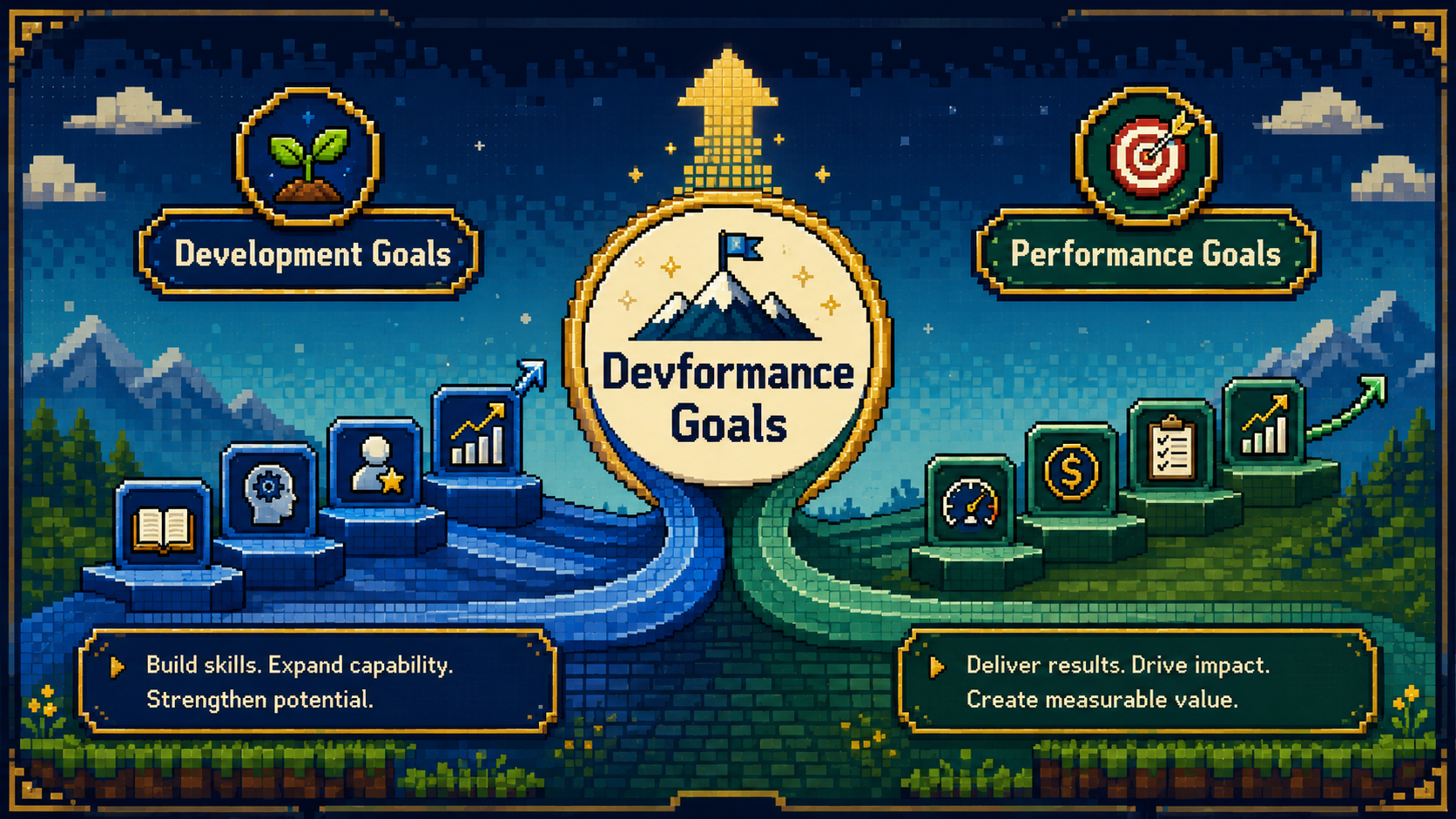
Most organisations separate development from performance.
One conversation asks: What do you need to learn? Another asks: What do you need to deliver?
I have never been convinced that these questions should live so far apart. Learning without application can become abstract, while performance without development can become unsustainable.
So why not connect them?
That is the idea behind what I call Devformance Goals.
A Devformance Goal combines a Development Goal with a Performance Goal. You develop a skill, capability or area of knowledge while using that development to achieve a measurable business outcome.
You do not only complete the level. You level up while doing it.
What is a Devformance Goal?
A Devformance Goal is a goal that deliberately combines development and performance in the same objective.
Traditional Development Goals focus on improving skills, knowledge or competencies. Traditional Performance Goals focus on delivering a specific result. Both matter, but they answer different questions.
A Development Goal might be:
Improve my data analytics capability.
A Performance Goal might be:
Reduce reporting turnaround time by 30%.
A Devformance Goal connects them:
Develop advanced data analytics capability and apply it to reduce reporting turnaround time by 30%.
Now learning has a purpose, and performance creates development.
That connection is the important part.
Development Goals build capability
Development Goals are primarily about becoming better equipped for the future. They might involve learning a new technology, developing leadership capability, improving negotiation skills, understanding a new market, strengthening communication, building financial knowledge or improving teamwork.
These goals may create significant long-term value even when they do not immediately produce a measurable financial outcome.
Think of an RPG. You spend time developing your character, acquiring new abilities, improving your equipment, increasing your stats and unlocking new parts of the skill tree.
You are becoming more capable.
But levelling up is not the objective of the game. Eventually, you need to use those abilities.
Performance Goals create the win condition
Performance Goals are different. They define what must actually happen.
Launch the product. Increase sales. Reduce cost. Improve service quality. Complete the project. Shorten cycle time. Increase customer satisfaction.
These are the mission objectives. They provide direction and a measurable definition of success.
The problem appears when performance becomes detached from capability. An organisation can continuously raise targets without asking whether the people expected to achieve them are developing the skills required to do so.
Eventually that becomes unsustainable.
You cannot indefinitely demand higher performance from the same capabilities, processes and resources. Something has to improve.
Why separate the two?
Imagine an employee development plan containing:
Improve presentation skills.
Fine. But why? Where will those skills be used? What will become better as a result?
Now imagine a performance target:
Increase executive approval of investment proposals.
Also reasonable. But perhaps one of the reasons proposals are struggling is that the person presenting them needs to become better at structuring complex information for senior decision-makers.
The two goals belong together.
A Devformance Goal could therefore be:
Develop executive presentation and storytelling skills and apply them to investment proposals, increasing first-round approval rates from X to Y.
The development is no longer a side activity. It becomes part of achieving the performance objective.
The problem with development that never leaves the classroom
Organisations spend significant amounts on training: courses, certifications, leadership programmes, conferences and learning platforms.
Some of that creates enormous value. Some of it becomes something employees complete because the system says they should.
The difference is often application.
You can attend an excellent course on negotiation, but if you never negotiate anything important afterwards, how much capability have you actually built? You can complete a data analytics programme, but if your job continues exactly as before, the organisation may never benefit from that investment.
Development becomes much more powerful when people have an immediate reason to use what they learn. That creates practice, feedback, iteration and eventually competence.
The opposite problem: performance without development
The opposite problem is just as common.
Someone performs well, so next year the target increases. They perform well again, and the target increases again. More responsibility arrives. More complexity. More stakeholders. More pressure.
But the person's capabilities, tools and support remain largely unchanged.
Eventually the system reaches its limit.
This is why development is not something that should happen only when performance is poor. High performers need development precisely because organisations expect them to keep performing in increasingly difficult environments.
Performance and development should reinforce each other.
Four ways to build Devformance Goals
There is no single template that works everywhere, but I find four combinations particularly useful.
1. Skill acquisition with a targeted outcome
Learn something new because achieving the performance objective requires it.
For example:
Develop advanced analytics capability and use it to reduce data analysis turnaround time by 30%.
The learning component is explicit, and so is the performance result.
This is much stronger than simply writing:
Complete advanced analytics training.
Completing the course is not really the objective. Using the capability is.
2. Competency improvement with measurable results
Sometimes the capability already exists. The objective is to become significantly better at it.
Imagine a leader responsible for improving an underperforming operation. A traditional Development Goal might be:
Improve Lean leadership capability.
The Performance Goal might be:
Reduce operating cost by 15%.
Combined:
Strengthen Lean leadership capability and apply it to redesign the operating model, targeting a 15% reduction in operating cost.
Again, capability and outcome reinforce each other.
3. Knowledge expansion with performance integration
Some objectives require deeper knowledge rather than a completely new skill. You might need to understand a market, a customer segment, a technology, a regulation, a competitor landscape or a business model.
The Devformance Goal should connect that knowledge directly to a decision or outcome.
For example:
Develop deeper knowledge of an emerging market and use that insight to create and execute the market-entry strategy.
Now "learning about the market" is not an isolated research exercise. It is preparation for execution.
4. Teamwork and leadership with goal alignment
Development does not have to be individual. Teams develop capabilities too.
A leader might need to become better at managing a distributed team while simultaneously delivering a difficult transformation.
A Devformance Goal might be:
Develop cross-functional leadership practices while leading the global team responsible for delivering the product launch on schedule.
The project becomes the environment in which leadership develops, and leadership development increases the probability that the project succeeds.
The performance target still needs to be credible
Combining learning and performance does not remove the fundamentals of good goal setting.
A bad target does not become good because you attach a development activity to it. The objective still needs appropriate ownership, assumptions, resources and alignment.
This connects directly to the Goal Trilemma.
The Goal Setter, Approver and Team Working Towards the Goal need a shared understanding of what is being asked. If someone is expected to learn an entirely new capability while simultaneously delivering an aggressive target, that additional learning effort needs to be recognised.
Development requires time. Practice requires time. Mistakes are part of learning.
Pretending otherwise simply hides another dependency inside the goal.
Do not confuse activity with development
Attend a leadership course is an activity.
Improve leadership capability is development.
Improve leadership capability and use it to increase the team's delivery reliability begins to resemble Devformance.
The objective is not the course. The objective is increased capability that contributes to improved performance.
That means the development side should also be observable. Did the person actually learn? Did behaviour change? Did the capability improve? Was it applied? Did it contribute to the intended result?
Training completion alone tells us very little.
Not every goal needs to be Devformance
I would not force this concept onto everything.
Some Performance Goals should simply be Performance Goals. Some Development Goals genuinely need space without an immediate business target attached. Learning something exploratory can create value that is impossible to quantify beforehand.
That is fine.
Devformance Goals are useful when there is a natural connection between what someone needs to become better at and what the organisation needs them to achieve.
Do not manufacture a connection simply to make the framework look complete.
The framework should serve the work, not the other way around.
Development can become a leading indicator of performance
There also matters for performance-management implication.
If future performance depends on capabilities that do not yet exist, development itself becomes part of the performance chain.
Suppose an organisation wants to automate a major process. The final Outcome KPI might be cost reduction. Before that comes process improvement. Before that comes technology adoption. But somewhere even earlier, people may need new skills to design, operate or manage the automated process.
Capability development therefore becomes an early signal.
If six months into the transformation nobody has developed the required skills, the final financial result may already be at risk.
That is why human capability belongs inside Enterprise Performance Management. People are not separate from execution. They are part of the system that produces it.
Devformance and the growth mindset
I also like how this changes the relationship with performance.
Development creates a different psychological relationship with performance.
A pure Performance Goal can become binary: hit or miss, green or red.
A Devformance Goal contains another dimension. What did we learn? What capability did we build? What are we now able to do that we could not do before?
That does not mean poor results should be excused because somebody learned something. Performance still matters.
But an organisation that continuously builds capability while pursuing results is better positioned for the next challenge than one that looks only at the current score.
Careers already work this way
When I look at my own career, most of the important development did not happen separately from work.
I learned by moving into unfamiliar environments: engineering, offshore operations, investment and portfolio management, transformation, performance management and data.
Each new challenge required me to learn something I did not fully understand before. And the learning mattered because there was an actual problem to solve.
That combination is powerful.
You are not learning because a development plan says you should. You are learning because you need the capability to succeed.
The mission creates the motivation. The development improves your chances of completing the mission.
How to write a Devformance Goal
A simple structure is:
Develop [capability] and apply it to [performance objective], measured by [result].
For example:
Develop advanced stakeholder-management capability and apply it to the transformation programme, increasing milestone acceptance from 70% to 90%.
Or:
Build advanced data-modelling skills and use them to automate the monthly reporting process, reducing preparation time from five days to two.
Or:
Develop coaching capability and apply it across the team, increasing internal readiness for critical roles over the next twelve months.
The exact wording matters less than the logic. There should be a visible connection between what you are learning and what that learning should help you achieve.
Review both sides of the goal
When reviewing a Devformance Goal, do not only ask whether the final KPI was achieved. Ask two sets of questions.
Development: What capability was supposed to improve? Did it improve? How do we know? Was the new capability actually applied?
Performance: What outcome was expected? Was it achieved? What contributed to the result? What prevented it?
Then look at the connection between them.
Did the development actually help performance?
If not, perhaps the wrong capability was developed. Or perhaps the assumed relationship between capability and outcome was wrong.
That is useful information too.
Development is an investment in future performance
Organisations often talk about people as their most important asset. The real test is whether they invest accordingly.
Development should not be something squeezed into whatever time remains after "real work" is finished. Building capability is part of the real work when future performance depends on it.
At the same time, development becomes more credible when it connects to genuine organisational needs.
That is the balance Devformance Goals try to create.
Development gives people the capacity to take on bigger challenges. Performance gives development direction and application.
One prepares you for the next level. The other gives you a reason to reach it.
Put them together and you get something more powerful than either one alone.
You do not only beat the level. You become a better player while doing it.
This article develops the Devformance Goals concept originally explored through my EPM Mondays series and later expanded in Performantria: Master the Game of Enterprise Performance Management.
Explore the full Performantria framework for Enterprise Performance Management.