A goal can be perfectly reasonable when it is created.
Then somebody approves it.
Somebody else increases it.
Another team adds a dependency.
The budget changes.
The people expected to deliver it discover that the assumptions no longer match reality.
And suddenly a good goal is no longer a good goal.
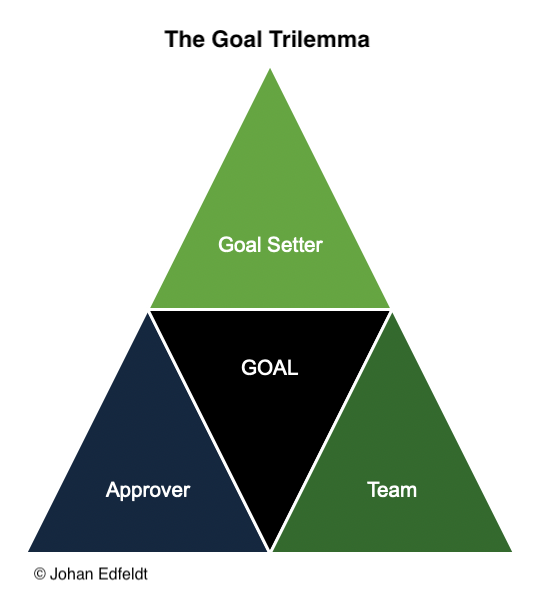
This is what I call The Goal Trilemma.
It is one of the concepts I developed while working with Enterprise Performance Management and later expanded in Performantria.
The idea is simple:
A goal does not exist in isolation.
Its success depends on three parties being aligned.
The Goal Setter
The Approver
The Team Working Towards the Goal
When those three perspectives are aligned, a goal has a reasonable foundation for success.
When they are not, even an excellent goal can fail.
What is the Goal Trilemma?
The Goal Trilemma is a framework for understanding the relationship between the person or function setting a goal, the person approving it, and the team responsible for delivering it.
These roles often see the same target from very different perspectives.
The Goal Setter may have performed the detailed analysis.
The Approver may be looking across a much broader organisational portfolio.
The Team may understand operational constraints that neither of the other two can see.
None of those perspectives is necessarily wrong.
The problem appears when one perspective changes the goal without properly understanding the others.
That creates misalignment.
And misalignment creates bad performance management.
Think of the Project Management Iron Triangle
The idea is partly inspired by one of the most familiar concepts in project management.
The Iron Triangle.
A project needs to balance:
Time.
Cost.
Scope.
Change one and something else usually moves.
If you shorten the schedule while keeping the scope fixed, you may need more resources.
Reduce the budget while keeping the deadline and scope unchanged, and you have created a different problem.
The constraints interact.
Goals work in a similar way.
But instead of balancing time, cost and scope, the Goal Trilemma balances the people involved in creating, approving and delivering the target.
The dependencies are less visible.
That is why they are so easy to ignore.
The Goal Setter
The Goal Setter is usually the person or team that develops the target.
Ideally, they understand:
What needs to be achieved.
Why it matters.
What the historical performance looks like.
Which resources are available.
What assumptions have been made.
What dependencies exist.
What level of improvement appears realistic.
A properly developed target therefore represents more than a number.
It is the result of analysis.
If that analysis suggests that 2.5% improvement is realistic, 2.5% should not automatically be interpreted as a lack of ambition.
It may simply be the best estimate supported by the information available.
That distinction matters.
A target should be challenging.
But there is a difference between challenging and imaginary.
The Approver
The Approver has a different responsibility.
They need to challenge assumptions.
They may have access to information that the Goal Setter does not.
They may see competing priorities across the organisation.
They may understand investor expectations, financial constraints or strategic ambitions at a different level.
That challenge is valuable.
The problem begins when challenge becomes arbitrary escalation.
A target should not increase simply because:
Last year's number was higher.
Another department has a higher target.
The number looks too small on a PowerPoint slide.
Or somebody wants a cleaner number to present upwards.
Ambition without understanding is not performance management.
It is wishful thinking.
The Team Working Towards the Goal
Then there is the team actually expected to deliver the outcome.
This perspective is often the most overlooked.
The team understands the operational reality.
They know where the bottlenecks are.
They know which dependencies are fragile.
They know whether the resources exist.
They know whether the timeline is realistic.
And they often know something else that becomes extremely important:
Whether they actually believe the goal is achievable.
You can approve a target without creating commitment.
If the team sees the number as arbitrary from the beginning, you have already created a performance problem.
When a 2.5% target becomes 10%
Here is an exaggerated version of a situation I have seen more than once.
A team performs the analysis.
They break the goal into components.
They examine historical performance, assumptions and available resources.
The conclusion is that a 2.5% improvement is challenging but achievable.
Then the goal begins travelling upwards.
A VP looks at the target and says:
2.5%?
Last year we achieved 4%.
Make it 4%.
The EVP sees targets from several other functions and thinks 4% does not look particularly ambitious.
Make it 7%.
Eventually it reaches the CEO.
Seven is an awkward number to explain to the Board.
Make it 10%.
Now imagine that the team eventually delivers 3%.
Against the original analysis, they have actually outperformed.
Against the final target, they have failed badly.
The manager is disappointed.
The manager's manager is disappointed.
Leadership sees red.
But what exactly failed?
The execution?
Or the goal-setting process?
Donkey Kong explains the problem surprisingly well
Think about the original Donkey Kong.
The objective is clear.
Reach the top.
Rescue Pauline.
Then the barrels start coming.
You adapt.
More barrels.
Fireballs.
Different platforms.
More obstacles.
Now imagine that somebody keeps moving Pauline further away every time you get closer.
That is what badly governed goal setting can feel like.
The team begins with a clear objective.
Then unexpected requirements and management changes are added while the goal remains supposedly unchanged.
Eventually the organisation is measuring the team's ability to dodge obstacles rather than its ability to achieve the original business outcome.
The Goal Trilemma makes those dependencies visible.
Alignment does not mean everyone has to agree immediately
This is important.
The Goal Trilemma does not mean that the Team gets to choose an easy target.
It does not mean the Goal Setter owns the final number.
And it does not mean senior management should stop challenging targets.
Challenge is healthy.
What matters is that the challenge becomes a discussion between the three perspectives.
If leadership believes 2.5% should really be 5%, ask why.
What assumption needs to change?
Can more resources be allocated?
Can the scope change?
Can another dependency be removed?
Is there evidence suggesting that higher performance is realistic?
Now you are having a performance conversation.
Simply replacing 2.5 with 5 is not the same thing.
Goals also collide across organisational boundaries
The Goal Trilemma becomes even more important when one team's target affects another team's target.
I experienced a simple example offshore.
Our operations team wanted to minimise the time specialist service personnel spent on the rig.
These specialists could be expensive.
If their work was finished, we wanted them on the next helicopter home.
Makes sense.
But the helicopter operations team had its own objective:
Reduce the number of helicopter flights.
That also makes sense.
Now we have two individually reasonable KPIs pushing the organisation in opposite directions.
One team saves money by sending people home quickly.
Another saves money by reducing flights.
Optimise either KPI in isolation and you may increase the total cost to the company.
This is why the Goal Approver needs to understand more than one target.
Enterprise performance is not the sum of locally optimised KPIs.
Sometimes the organisation needs to sacrifice one local measure to improve the overall outcome.
A green KPI can still be bad performance
This leads to one of the dangers of performance management.
Local optimisation.
Imagine Team A has a green KPI.
Team B also has a green KPI.
Yet together their decisions create a worse outcome for the enterprise.
Both teams can technically claim success.
The company loses.
That is why performance governance needs to connect goals across functions.
The question should not only be:
Did you achieve your target?
It should also be:
Did achieving your target help the organisation achieve its objective?
Those are not always the same thing.
Be careful when changing targets
Targets sometimes genuinely need to change.
The world changes.
Budgets disappear.
Markets move.
Priorities shift.
Dependencies fail.
But changing a target should be a governed decision.
The same perspectives involved in establishing the goal should understand why it is being changed.
Otherwise, the organisation loses the integrity of the original agreement.
My preference is usually to first analyse the deviation and adjust the strategy rather than immediately rewriting the target.
If performance falls behind, ask:
Why?
What changed?
Can we alter the approach?
Can resources move?
Can a dependency be solved?
What have we learned?
Changing the target should not become the easiest way to make a red KPI green.
Imagine doing this outside your company
Some organisational behaviour becomes absurd when you move it outside the office.
Imagine walking into a restaurant.
A sirloin steak costs $25.
You tell the restaurant:
I am only giving you $20.
But I still want exactly the same steak.
Same quality.
Same size.
Same service.
Same delivery time.
The restaurant will probably tell you that something has to change.
Yet organisations regularly do the equivalent internally.
Here is 80% of the budget.
The deadline stays the same.
The scope stays the same.
The quality must stay the same.
And the target stays the same.
Then everyone acts surprised when performance suffers.
Constraints matter.
Pretending they do not exist does not make the goal more ambitious.
It makes the plan less credible.
How to use the Goal Trilemma
Before finalising an important goal, make the three perspectives explicit.
Who is setting the goal?
Who approves it?
Who actually has to deliver it?
Then make the assumptions visible.
What data supports the target?
What resources are assumed?
Which teams does it depend on?
Which other goals could conflict with it?
What happens if one of those assumptions changes?
Most importantly, create the discussion before the target is locked.
It is much easier to challenge an assumption during planning than to explain six months later why the target was impossible from the beginning.
Goal setting is governance
This is why I see goal setting as part of Enterprise Performance Management rather than a standalone annual exercise.
Goals connect strategy with execution.
They determine what receives attention.
They influence resource allocation.
They shape KPIs.
They affect incentives.
And they tell teams what the organisation considers important.
A poorly governed goal therefore creates consequences far beyond one number on a scorecard.
It can make people optimise the wrong behaviour.
It can create conflicts between functions.
It can damage trust.
It can make good performance look bad.
And perhaps worst of all, it can make people stop believing in the performance system itself.
The goal is alignment, not perfection
Even a perfectly aligned Goal Trilemma does not guarantee success.
Things still go wrong.
Assumptions fail.
Markets change.
People make mistakes.
That is business.
The point is to create a common foundation from which those discussions can happen.
The Goal Setter understands why the target was approved.
The Approver understands the assumptions beneath it.
The Team understands what it is committing to.
And when reality changes, everyone has the same starting point for deciding what to do next.
A good goal should create direction.
Not confusion.
Not politics.
Not a number that gradually changes as it travels through the organisation.
If the Goal Setter, Approver and Team are not aligned, you do not really have one goal.
You have three different interpretations of one.
And sooner or later, the barrels will start coming.
This article develops the Goal Trilemma concept originally shared through my EPM Mondays series and later expanded in Performantria: Master the Game of Enterprise Performance Management.
Explore the full Performantria framework for Enterprise Performance Management.