
BLOG
Strategic Performance Governance: Connecting Strategy with Execution
Most organisations do not struggle to create strategies.
They struggle to keep the organisation connected to them.
A strategy can look clear in a presentation. The objectives make sense. The priorities have been approved. Leadership leaves the room aligned.
Then the organisation starts moving.
Functions interpret the strategy differently. Targets evolve. Projects compete for resources. KPIs become disconnected from the original objective. Decisions happen at different levels, often using different information.
Six months later, everyone is busy, but it becomes surprisingly difficult to answer a simple question:
Are we actually executing the strategy we agreed?
That is the problem Strategic Performance Governance is meant to solve.
What is Strategic Performance Governance?
Strategic Performance Governance is the structure that connects an organisation's long-term direction with the decisions, responsibilities, measures and actions used to deliver it.
In the Performantria framework, I place Strategic Performance Governance at the centre of Enterprise Performance Management.
That is intentional.
Governance is what keeps the other parts of performance management connected.
Strategy, goals, KPIs, data, people, portfolios, risk and transformation can all work reasonably well in isolation while the organisation as a whole still moves in several different directions.
Good governance creates the shared rules of the game.
Who decides? Who owns? What are we trying to achieve? Which measures matter? How is performance reviewed? What happens when reality changes?
And perhaps most importantly:
How do we make sure local decisions still support the overall objective?
Governance is more than policies
The word governance often creates the wrong image.
Committees. Policies. Approval flows. Documents nobody reads.
Those things may form part of governance, but they are not the objective.
Governance should make decision-making clearer. It should create enough structure for people to understand what they are accountable for, where decisions belong and how their work connects to the organisation's objectives.
If governance only creates additional administration, something has gone wrong.
The purpose is not to govern more.
The purpose is to help the organisation stay aligned while it executes.
Governance sits at the centre of Enterprise Performance Management
I often visualise the Performantria framework as a wheel.
Strategic Performance Governance sits at the hub.
Around it sit the other knowledge areas: performance measurement, data, analytics, operational excellence, human capital, stakeholders, risk, portfolios and transformation.
The hub matters because those areas are interdependent.
A KPI without ownership is just a number. A portfolio without strategic alignment can deliver projects that do not matter. Reliable data is valuable, but someone still needs to decide what the organisation should do with it. A transformation programme can deliver successfully while moving the organisation towards the wrong destination.
Governance creates the connection.
It is not simply about tracking performance. It establishes the rules, accountability and decision structure that keep different parts of the organisation moving towards a shared objective.
Four goals of Strategic Performance Governance
In Performantria, I structure Strategic Performance Governance around four goals:
Strategic Alignment
Accountability
Adaptive Agility
Ethical Guardrails
They are deliberately different.
Together they create the balance between direction, ownership, adaptability and responsible decision-making.

Structured Overview of Knowledge Areas. This diagram summarize each Knowledge Area by breaking it down into core components: Goals (strategic objectives), Business Drivers (factors for success), Core Inputs (necessary resources), Key Activities (actions to achieve goals), and Deliverables (tangible outputs). Stakeholders are grouped as Suppliers, Participants, and Consumers, while Technical Drivers are divided into Techniques and Tools. KPIs track progress, and a Gaming Analogy offers a relatable metaphor for each area. This structure provides a clear, cohesive view of each Knowledge Area within the organization’s strategic framework.
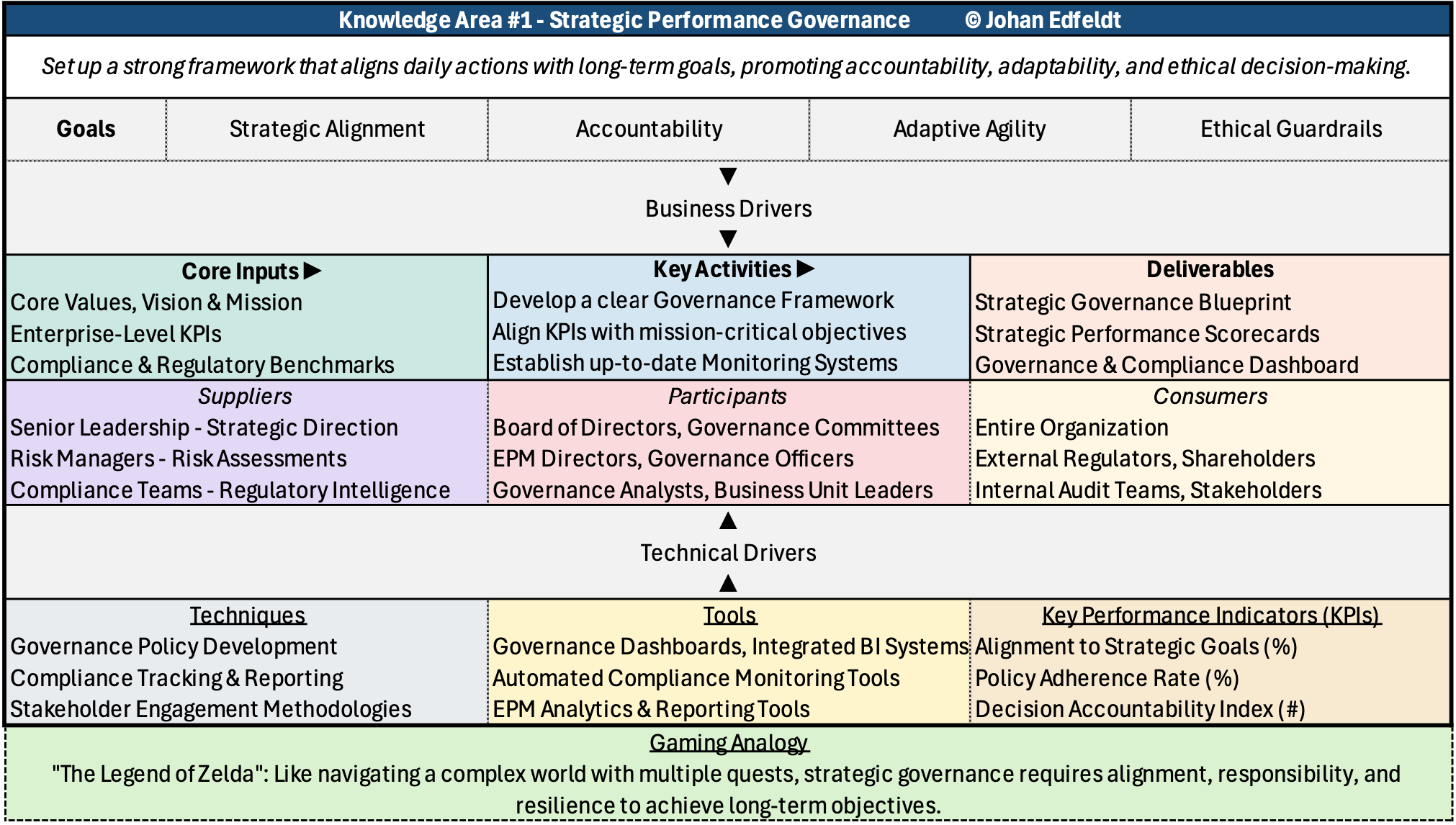
Strategic Performance Governance Framework. This diagram outlines the Strategic Performance Governance framework, breaking it down into core elements: Goals, Business Drivers, Core Inputs, Key Activities, Deliverables, Stakeholders, Technical Drivers, KPIs, and Gaming Analogy. Each section is designed to support organizational alignment with strategic goals, accountability, and adaptability, providing a clear structure for governance initiatives.
If you're keen on, for example learning more about the example KPIs listed, take a look here:

These are the three example KPIs on Strategic Performance Governance. Governance is often "fluffy" and a bit unclear. I recommend you to explore it from a pragmatic approach and ensure that, before you implement, understand creation time here.
1. Strategic Alignment
Strategic Alignment means connecting what the organisation says matters with what people actually do.
That sounds obvious.
It rarely is.
An organisation may have five strategic priorities while functions operate with fifty local ones. Leadership may focus on growth while one department optimises cost. A transformation programme may improve a local process while creating problems elsewhere.
Every individual initiative can appear rational.
The total system can still be misaligned.
Strategic governance therefore needs a visible connection from:
Mission and vision → strategic objectives → goals → KPIs → initiatives → actions
The objective is not to turn this into an enormous hierarchy that nobody can maintain.
It is to preserve traceability.
If a major KPI, investment or initiative cannot be connected back to something the organisation is trying to achieve, ask why it exists.
2. Accountability
Alignment tells us where we are going.
Accountability tells us who is responsible for getting there.
One of the fastest ways to weaken a performance system is unclear ownership.
Everyone is involved. Everyone has an opinion. Everyone receives the dashboard.
Nobody actually owns the outcome.
Good governance makes responsibility explicit.
Who owns the objective? Who approves the target? Who owns the KPI? Who can make a decision when performance deviates? Who is responsible for the corrective action? Who needs to be consulted? Who needs to know?
Accountability does not mean that one person performs all the work.
It means that responsibility does not disappear into the organisation.
This is also where the Goal Trilemma becomes relevant.
The Goal Setter, the Approver and the Team Working Towards the Goal may all have legitimate but different perspectives. Governance needs to make those relationships visible before an apparently simple target becomes three different interpretations of the same objective.
3. Adaptive Agility
Governance also needs stability.
But stability is not the same as rigidity.
Markets change. Customers change. Technology changes. Risks appear. Assumptions fail.
A governance structure that cannot adapt eventually becomes disconnected from reality.
Adaptive Agility therefore means creating enough flexibility to respond to change without abandoning the strategic direction every time something moves.
That distinction matters.
Changing the strategy should be deliberate. Changing a target should be governed. Changing priorities should create consequences elsewhere in the plan.
Otherwise, adaptability becomes an excuse for constant reprioritisation.
Good governance gives the organisation a stable reference point while still allowing decisions to evolve as new information appears.
Think of a game map.
The destination may remain the same even when you discover that the route you planned is blocked.
You adapt the route.
You do not automatically abandon the quest.
4. Ethical Guardrails
Performance creates pressure.
Targets create incentives.
And incentives influence behaviour.
That is why ethics belongs inside performance governance rather than sitting beside it.
A badly designed target can encourage people to optimise the number instead of the outcome. A cost target can encourage inappropriate shortcuts. A sales target can reward behaviour that creates customer problems later. A local KPI can improve while the enterprise becomes worse off.
Ethical guardrails establish boundaries around how performance should be achieved.
Not every path to a green KPI is an acceptable one.
This includes compliance and regulation, but it goes further.
The question is not only:
Did we achieve the target?
It is also:
Did we achieve it in a way that is consistent with our values, responsibilities and long-term interests?
Sustainable performance requires both.
Strong governance needs strong inputs
Governance cannot operate in a vacuum.
In the Performantria framework, several inputs are particularly important.
Core Values, Vision and Mission
These establish direction and boundaries.
Enterprise-Level KPIs
These provide visibility into whether the organisation is actually progressing towards its objectives.
Compliance and Regulatory Benchmarks
These establish constraints the organisation must understand and respect.
Weak inputs create weak governance.
If the strategy is ambiguous, alignment becomes difficult. If the KPIs are poorly defined, decision-making becomes unreliable. If the underlying data cannot be trusted, governance discussions turn into arguments about numbers.
The governance layer therefore depends on the quality of the systems beneath it.
Translate governance into actual work
A governance framework only creates value when it changes how the organisation operates.
In Performantria, three activities sit at the core of Strategic Performance Governance:
Develop a clear Governance Framework
Define how performance governance works, including ownership, decision rights, responsibilities and principles.
Align KPIs with mission-critical objectives
Measures should help the organisation understand progress towards the outcomes that actually matter.
Establish up-to-date Monitoring Systems
Decision-makers need timely visibility into performance, risks and deviations.
These activities create tangible outputs rather than abstract governance theory.
A Strategic Governance Blueprint.
Strategic Performance Scorecards.
A Governance and Compliance Dashboard.
The specific artefacts will vary by organisation.
The underlying principle does not.
Governance needs to become visible enough that people can actually use it.
The dashboard still does not govern anything
This distinction is worth making.
A dashboard can show performance.
It cannot create accountability. It cannot resolve conflicting objectives. It cannot decide whether a target should change. It cannot determine whether a local optimisation damages the enterprise. It cannot tell people which decision belongs at which organisational level.
Those are governance questions.
The technology supports the system.
It is not the system.
The same principle applies across Enterprise Performance Management: better technology can strengthen good foundations, but it rarely compensates for weak ones.
Governance and the Performance Operating System are different
Strategic Performance Governance and the Performance Operating System are closely connected, but they are not the same thing.
Governance establishes the framework.
The POS creates the operating rhythm.
Governance helps answer:
What matters? Who owns it? Who decides? Which rules apply? What should be measured?
The Performance Operating System then brings those decisions into normal operations through different review cycles, performance discussions, escalation and follow-up.
You need both.
Governance without an operating rhythm risks becoming theoretical.
An operating rhythm without governance risks becoming a calendar full of meetings with no consistent direction.
Decisions should happen at the right level
Good governance does not mean escalating everything upwards.
Quite the opposite.
If every performance deviation requires executive attention, the governance model is probably failing.
Operational decisions should normally happen close to operations. Cross-functional problems should move to the level where the dependencies can be resolved. Strategic decisions should reach leadership when they genuinely require leadership.
The objective is not maximum central control.
It is clear decision authority.
Senior leaders have limited attention.
Governance should help protect that attention for the questions that genuinely require it.
KPIs need governance too
KPIs are often treated as if they simply appear.
They do not.
Somebody defines them. Somebody chooses the data. Somebody sets the target. Somebody decides how often they are reviewed. Somebody determines whether green is good enough.
Those choices need governance.
A useful KPI therefore needs more than a name and a number.
Its purpose should be understood. Its definition should be stable. Its ownership should be clear. Its data should be trustworthy. Its relationship with strategic objectives should be visible. And changes should be controlled.
This is where Strategic Performance Governance connects directly with KPI Dimensions and Data Governance.
A sophisticated performance model built on ambiguous definitions is still ambiguous.
Govern the performance system itself
There is another layer that organisations sometimes overlook.
The performance system itself should be reviewed.
Are the governance structures still useful? Are the KPIs still aligned with strategy? Are decision rights clear? Are governance forums making decisions or merely exchanging information? Are policies still relevant? Are issues being escalated to the right level? Does accountability actually exist, or only appear in a RACI document?
Governance should not become permanent simply because it was designed once.
The organisation changes.
The governance model needs to remain relevant.
That does not mean constantly rebuilding it.
It means periodically asking whether it still does the job it was created to do.
How do you measure governance?
Governance can feel difficult to measure because much of its value comes from better decisions, clearer accountability and stronger alignment.
But that does not mean it should remain completely abstract.
In the Performantria framework, examples of governance measures include:
Alignment to Strategic Goals
How much of the organisation's important work can genuinely be connected to agreed strategic objectives?
Policy Adherence Rate
Are critical governance requirements actually being followed?
Decision Accountability
Are important decisions connected to clear ownership and follow-up?
These are examples rather than universal KPIs.
The right measures depend on the organisation.
The important point is that governance should be judged by whether it improves the system, not by how many governance meetings were held or how many documents were produced.
Activity is not the same as effectiveness.
Think of The Legend of Zelda
One of the gaming analogies I use for Strategic Performance Governance is The Legend of Zelda.
The world contains multiple paths, quests, obstacles, tools and decisions.
You can wander almost anywhere.
But movement alone does not mean progress.
You need to understand the larger objective.
Some paths move you closer to it.
Others lead to dead ends.
You collect information, adapt to obstacles and decide where to go next, while keeping the broader quest in mind.
Organisations work in much the same way.
Thousands of activities happen every day. Projects begin. Decisions are made. Resources move. Problems appear.
Governance provides the map and rules that help those activities remain connected to the larger objective.
Without that structure, the organisation can be extremely busy while making surprisingly little progress.
Governance should create clarity
The strongest governance systems are not necessarily the most complicated ones.
They are the ones people understand.
People know what matters. They know what they own. They know where decisions belong. They know which information can be trusted. They understand how their work connects to the organisation's objectives.
And when reality changes, they know how the organisation should respond.
That is the purpose of Strategic Performance Governance.
Not more committees.
Not more slides.
Not more controls for their own sake.
Clarity, accountability and alignment from strategy through execution.
That is why governance sits at the centre of the Performantria framework.
This article replaces and expands material originally published through my EPM Mondays series and later developed into the Strategic Performance Governance knowledge area in Performantria: Master the Game of Enterprise Performance Management.
Explore the full Performantria framework for Enterprise Performance Management.

What Is a Performance Operating System (POS)? Turning Strategy into Execution

Most organisations do not have a strategy problem.
They have an execution problem.
The strategy exists. The targets have been approved. The KPIs are sitting in a dashboard somewhere.
Then normal business takes over.
Meetings happen. Problems appear. Priorities change. Data arrives late. Decisions are postponed.
And gradually, strategy and execution drift apart.
That is where a Performance Operating System, or POS, becomes useful.
What is a Performance Operating System?
In Performantria, I define a Performance Operating System as a structured system that integrates performance management into normal business operations, ensuring that strategic goals are consistently monitored, pursued and acted upon.
The important word is operating.
Performance management should not be something an organisation does once a quarter when somebody opens a PowerPoint deck.
It should be part of how the organisation operates.
A Performance Operating System connects:
Strategy
Key Performance Indicators
Data
Performance reviews
Decision-making
Corrective actions
Accountability
Follow-up
The purpose is simple:
Detect when performance begins to drift and act while there is still time to change the outcome.
Think of X-COM
One of my favourite ways to explain the idea comes from the classic game UFO: Enemy Unknown, also known as X-COM: UFO Defense.
The game essentially operates at two levels.
The Geoscape gives you the strategic overview.
You manage bases, research, funding, equipment and the overall defence of Earth.
Then there is the Battlescape.
That is where you zoom in.
You see what is actually happening on the ground and make tactical decisions based on the situation in front of you.
That is a useful analogy for an organisation.
The broader Enterprise Operating System provides the organisational structure connecting strategy, processes and functions.
The Performance Operating System zooms in on performance.
It monitors what is happening, identifies deviations and creates a structured rhythm for deciding what to do next.
You need both perspectives.
Strategy without operational feedback becomes disconnected from reality.
Operations without strategic direction becomes activity without purpose.
The problem with the monthly performance review
A monthly performance review sounds simple.
Get everyone together.
Open the dashboard.
Look at the KPIs.
Discuss what is red.
Agree some actions.
Done.
Except that this is often exactly where performance management starts to fail.
The data may not be ready.
The meeting may happen too late.
There may be 50 KPIs and no clear priorities.
People explain performance rather than improve it.
The discussion becomes historical:
Why did this happen?
Why was that missed?
Who owns this?
By the time everybody agrees, another month has passed.
A Performance Operating System should instead function as an Early Warning System.
If your organisation identifies a serious performance deviation months after it happened, you have built a Late Warning System.
Accurate historical reporting still has value.
But it is not enough.
Match the rhythm to the problem
Not every performance issue belongs in the same meeting.
This is why I use different control intervals inside the Performance Operating System.
Short Interval Control - SIC
Daily or weekly.
SIC operates close to the work.
It should focus on information that can trigger relatively immediate action.
Examples might include operational throughput, service disruptions, safety indicators, backlog or another measure where waiting until the end of the month would be unnecessary or damaging.
The people closest to the issue should generally be empowered to act.
You should not need an executive committee to solve every operational deviation.
Medium Interval Control - MIC
Monthly.
This is where the traditional monthly performance review fits.
MIC provides enough time to identify meaningful trends while remaining frequent enough to intervene.
The discussion can move beyond individual events and ask:
What is changing?
Where are we deviating from target?
Is this temporary or structural?
What is causing it?
What do we need to change?
Who owns the action?
Long Interval Control - LIC
Quarterly.
LIC provides the broader strategic perspective.
Here the objective is not to repeat twelve weeks of operational reporting.
It is to step back.
Are we still pursuing the right objectives?
Are the KPIs still relevant?
Has the environment changed?
Are resources allocated to the right priorities?
Do we need to change the plan?
Different intervals create different perspectives.
That is the point.
Use leading information where action is still possible
A useful Performance Operating System should gradually shift attention towards indicators that allow the organisation to act before the final outcome is known.
Imagine only managing sales by looking at annual revenue.
You will eventually know whether you succeeded.
You just will not have much time left to do anything about it.
Earlier indicators might show:
Pipeline development
Customer activity
Adoption
Process performance
Delivery progress
Operational constraints
These do not replace outcome KPIs.
They complement them.
The further away you are from the final outcome, the more uncertainty exists.
But you also have more opportunity to act.
That trade-off is central to good performance management.
Do not review everything at the same level
Another common mistake is taking every issue upwards.
A well-designed POS should allow decisions to happen at the appropriate organisational level.
Some deviations belong close to operations.
Others require cross-functional coordination.
Some require management decisions.
A small number require executive attention.
This creates an important principle:
Escalate the issue, not the entire performance system.
Senior leaders should not spend their limited attention reviewing every operational measure.
Likewise, frontline teams should not have to wait for quarterly leadership meetings to fix problems they already understand.
The operating rhythm should connect these levels without collapsing them into one giant meeting.
Separate the past from the future
I like to think about performance discussions through two perspectives:
Past
What happened?
Where did we deviate?
What can we learn?
Future
What are we going to do?
What risks are emerging?
What decisions are required?
What happens if we do nothing?
Both matter.
Performance management fails when the meeting becomes exclusively historical.
A perfect explanation of why you missed the target is still a missed target.
The purpose of understanding the past is to improve the future.
The dashboard is not the Performance Operating System
This distinction matters.
A dashboard is a tool.
The Performance Operating System is the operating model around it.
You can have an excellent dashboard and a terrible performance system.
If ownership is unclear, definitions are inconsistent, meetings lack structure or nobody follows up on actions, better visualisations will not solve the problem.
Likewise, you can run an effective performance rhythm using relatively simple technology if the fundamentals are strong.
The system matters more than the screen.
Your performance review needs rules
Performance meetings benefit from something surprisingly basic:
A clear Terms of Reference.
Define:
Why does this meeting exist?
Which decisions should be made here?
Which KPIs belong here?
Who participates?
Who owns each measure?
What data must be available beforehand?
How are actions documented?
How are unresolved issues escalated?
When will actions be reviewed?
A monthly performance review should not simply exist because there has always been a monthly performance review.
It should have a job to do.
Keep the number of KPIs manageable
Performance systems naturally accumulate measures.
Someone asks for another metric.
A new project introduces three more.
A regulatory requirement adds another dashboard.
Before long, leadership is staring at dozens or hundreds of indicators.
More information does not automatically create more insight.
The KPIs in a Performance Operating System should provide enough information to understand the business without overwhelming the people expected to act on it.
Detailed analysis can always exist underneath.
The primary view should answer:
Where are we?
Where are we going?
Where are we deviating?
Where do we need to act?
Strategic meetings should not become bigger performance reviews
There is also a temptation to take the monthly performance pack into every strategic meeting.
I would avoid that.
If routine performance is already handled through SIC and MIC, use strategic sessions differently.
Go deeper into one important problem.
Examine a structural constraint.
Challenge an assumption.
Explore a major opportunity.
Review whether the strategy itself needs adjustment.
Do not use expensive leadership time simply to repeat information people have already seen.
Strategy needs space to look forward.
Start with what you have
You do not need a giant transformation programme to establish a Performance Operating System.
Start small.
Define the important strategic objectives.
Identify the KPIs that genuinely help you understand progress.
Clarify ownership.
Agree the data source.
Create a simple reporting structure.
Establish the review rhythm.
Define SIC, MIC and LIC where they add value.
Document actions and decisions.
Then improve the system as you learn.
I have seen organisations become trapped looking for the perfect framework or technology before fixing their basic operating rhythm.
Do the opposite.
Build the rhythm first.
Technology can support it later.
From reporting to execution
Ultimately, a Performance Operating System should create a continuous loop:
Measure → Understand → Decide → Act → Follow up → Learn
Then repeat.
That loop is where strategy becomes execution.
The dashboard tells you the score.
The Performance Operating System helps you decide how to play the next move.
And just like the Battlescape in X-COM, the value comes from seeing what is happening early enough to change the outcome.
That is the difference between reporting performance and actually managing it.
This article develops ideas originally shared through my EPM Mondays series and later expanded in Performantria: Master the Game of Enterprise Performance Management.
Explore the full Performantria framework for Enterprise Performance Management.

What Is Enterprise Performance Management? The Performantria Framework

Performance management is broken.
Endless reviews. Useless KPIs. Forgotten strategies.
We do not need more dashboards. We need clarity.
That idea sits at the heart of how I think about Enterprise Performance Management, or EPM.
Over the years, working across offshore energy, chemicals, portfolio management, transformation, data and global logistics, I kept seeing the same problem in different forms.
Organisations usually had strategies.
They had targets.
They had KPIs.
They had reports, dashboards, meetings and increasingly sophisticated technology.
Yet the connection between all of them was often surprisingly weak.
That is why I started developing what eventually became the Performantria framework.
What is Enterprise Performance Management?
I define Enterprise Performance Management as a comprehensive approach to managing organisational performance by connecting strategy, processes, people, data and technology to the objectives the organisation is trying to achieve.
The word enterprise matters.
Performance management should not simply be a finance process, a monthly reporting exercise or a dashboard owned by one department.
It should help the organisation answer a much broader set of questions:
What are we trying to achieve?
How do we know whether we are succeeding?
Who owns the outcome?
Is the underlying data trustworthy?
Are different parts of the organisation pulling in the same direction?
What do we do when performance moves away from the target?
How do we turn what we learn into action?
That requires more than measurement.
It requires a system.
The lesson that started on an offshore rig
One of the strongest lessons I learned about performance came from an unlikely place.
An ageing offshore drilling rig in Qatar.
When I first arrived, much of the equipment looked old. The rig had none of the technological polish you might associate with a high-performing operation.
Yet it was one of the strongest-performing rigs in the area.
Why?
Because the people knew what they were doing.
Roles were clear. Decisions mattered. Information moved quickly. The crew understood the operation and knew how to get the maximum value from the equipment they already had.
It taught me something I have carried into every role since:
High performance does not come from having the newest tools. It comes from people working effectively within an operating model that gives them clarity, information and direction.
Technology can strengthen that system.
It cannot replace it.
The same is true in modern organisations. A new dashboard will not solve weak ownership. An analytics platform will not fix badly defined KPIs. AI will not magically repair poor governance.
You need the foundations first.
Why EPM needs a framework
Imagine playing The Legend of Zelda without a map.
You might eventually reach the destination, but you will probably spend a lot of time walking into dead ends.
That is how performance management can feel inside a complex organisation.
Individual components may work reasonably well, but the organisation lacks a shared map showing how they fit together.
A framework provides that map.
The Performantria framework therefore looks at Enterprise Performance Management through ten interconnected knowledge areas.
1. Strategic Performance Governance
The centre of the framework.
Governance connects organisational purpose and strategy with accountability, decision-making and performance.
It establishes the rules of the game: who decides, who owns, how performance is reviewed and how the organisation maintains alignment when conditions change.
2. Performance Measurement and Financial Alignment
KPIs need to tell us something useful.
This area connects performance measurement with strategy and financial reality, covering KPI development, benchmarking, financial planning and resource allocation.
The objective is not to measure everything.
It is to measure what helps us understand and improve performance.
3. Data Management and Technological Integration
A KPI is only as trustworthy as the data beneath it.
Performance management therefore depends on data governance, data quality, stewardship, accessibility and appropriate technology.
If the foundations are weak, the dashboard simply presents unreliable information more beautifully.
4. Analytics and Quality Control
Data becomes useful when it helps us understand what is happening and why.
This area covers performance analysis, quality standards, insight communication and reporting.
Knowing that a KPI is red is rarely enough.
The important question is what the organisation learns from it and what should happen next.
5. Performance Excellence
Performance management should ultimately lead to improvement.
That means looking beyond reporting towards operational innovation, improvement methodologies and better ways of working.
Measurement is not the destination.
Better performance is.
6. Human Capital and Organisational Development
Organisations do not execute strategies. People do.
Performance assessment, talent development and a culture of performance therefore belong inside EPM rather than sitting outside it.
People need both the capability and the motivation to deliver.
7. Customer Satisfaction and Stakeholder Management
Performance cannot be understood entirely from inside the organisation.
Customers, partners, investors and other stakeholders experience the outcomes of our decisions.
Their expectations and perspectives therefore need to form part of how performance is defined, measured and managed.
8. Risk Management and Adaptive Change
Plans rarely survive reality unchanged.
Performance management needs to identify risks, respond to change and help the organisation adapt without losing sight of its objectives.
Good performance systems provide both structure and flexibility.
9. Portfolio Performance
Individual projects can succeed while the overall portfolio fails.
Portfolio performance therefore asks whether resources, investments, risks and opportunities are being managed collectively in support of strategic objectives.
The purpose is not simply to deliver every project.
It is to build the right portfolio and maximise its overall value.
10. Performance Transformation
Finally, EPM itself needs to evolve.
Digital technology, process improvement and transformation can strengthen how organisations manage performance, but transformation should remain connected to business outcomes.
Technology is an enabler.
It is not the objective.
Governance sits at the centre
I often visualise the framework as a wheel.
Strategic Performance Governance sits at the hub, connected to every other area.
That is intentional.
Governance is what connects goals, data, people, portfolios, risk, customers and transformation into one system.
Without governance, each area can become its own isolated activity.
Finance reports one number.
Operations reports another.
Projects optimise locally.
Functions set competing targets.
Data teams debate definitions.
Leadership receives several dashboards that appear to describe different organisations.
Strong governance creates the shared structure that keeps those pieces connected.
Every knowledge area follows the same logic
To make the framework usable rather than theoretical, each knowledge area can be examined through a common structure:
Goals
What is this area trying to achieve?
Business Drivers
Why does it matter?
Core Inputs
What information, resources or foundations does it require?
Key Activities
What actually needs to be done?
Deliverables
What tangible outputs should those activities produce?
Stakeholders
Who supplies information, who participates and who consumes the outcome?
Techniques and Tools
How is the work performed and supported?
KPIs
How do we know whether the area itself is working?
This creates consistency without pretending that every organisation should operate identically.
The framework is a map, not a commandment.
Adapt it to your organisation.
Five concepts that sit inside the framework
As I developed Performantria, several recurring problems needed their own models.
The Goal Trilemma
Goals are rarely created and executed by the same person.
There are usually three perspectives:
The Goal Setter
The Approver
The Team Working Towards the Goal
Misalignment between those three can turn an apparently sensible target into frustration, conflicting priorities or an unrealistic commitment.
The Goal Trilemma makes that relationship explicit.
KPI Dimensions
Traditional KPI discussions often stop at leading versus lagging indicators.
Real organisations are more complicated.
I prefer to look at KPIs across several dimensions, including outcomes, performance, processes, adoption and deliverables.
One number rarely tells the whole story.
Ruthless Prioritisation and Integrated Planning
Most organisations do not suffer from a shortage of ideas.
They suffer from too many priorities.
Ruthless Prioritisation and Integrated Planning, RPIP, is about making deliberate choices, concentrating resources on what matters most and connecting priorities to an integrated plan.
Prioritisation is easy to talk about.
Actually stopping work is harder.
Devformance Goals
Organisations often separate performance goals from development goals.
I think that division can be unnecessarily limiting.
Devformance Goals combine the two.
The idea is simple: deliver something valuable today while deliberately building the skills or capabilities needed for tomorrow.
In games, you do not only complete the level.
You level up.
The Performance Operating System
Strategy without execution is wishful thinking.
The Performance Operating System, POS, embeds performance management into the operating rhythm of the organisation.
It connects KPIs, reviews, decisions and follow-up so performance management becomes part of normal business rather than an isolated quarterly ritual.
Performance should be monitored at different frequencies, from short interval operational control to monthly management reviews and longer-term strategic perspectives.
The objective is to identify deviations early enough to act.
A Late Warning System is not particularly useful.
EPM is not about creating more bureaucracy
This may be the most important point.
Enterprise Performance Management should make an organisation easier to understand and steer.
If governance adds meetings without improving decisions, something is wrong.
If a KPI catalogue grows but nobody knows which measures matter, something is wrong.
If dashboards become more sophisticated while trust in the underlying data falls, something is wrong.
The purpose of EPM is not to build the biggest performance system.
It is to create enough structure to answer a simple question:
Are we moving towards what matters, and if not, what are we going to do about it?
Start with what you have
You do not need perfect systems to begin.
Start with the strategy.
Identify what really matters.
Choose a manageable number of meaningful KPIs.
Define what they mean and where the data comes from.
Clarify ownership.
Establish a regular review rhythm.
Discuss deviations openly.
Then decide what action is required.
Improve the system as you learn.
That lesson takes me back to the offshore rig.
The newest technology would not automatically have made that crew better.
They performed because people, information, experience and operating discipline worked together.
That, ultimately, is what Enterprise Performance Management should achieve.
Not more reporting.
Not more bureaucracy.
Clarity, alignment and action.
That is the game.
And the objective is not simply to keep score.
It is to improve how you play it.
This article brings together ideas originally developed through my EPM Mondays series on LinkedIn and later expanded in Performantria: Master the Game of Enterprise Performance Management.
Explore the full Performantria framework for Enterprise Performance Management.
From Fiction to Enterprise Performance Management: A New Chapter Begins 📚➡️📊
So, what's the latest in my world of writing? Well, it’s a bit of a plot twist… As many of you know, my career has always been rooted in performance. Whether it’s simulating the future of wind farms 🌬️, optimizing CAPEX-heavy portfolios 💰, or leading high-performing teams in offshore oil and gas operations ⛽, performance has been at the core of my journey.
But here’s the thing—I've always been driven by a deeper desire to understand what truly moves the needle and then share that knowledge with others. That’s where my love for writing comes in. 📚 Over the years, I’ve wondered how I could blend my passion for storytelling with my professional expertise in performance. And that’s how Enterprise Performance Management (EPM) was born.
What makes my EPM more approachable, in my view, is two-fold. First, I’ve developed a fixed reference point—a framework that helps bring clarity to what often seems like complex concepts. Second, I contextualize it with my hobbies and interests, from retro gaming 🎮, 80s movies 🎥, and fantasy 🏰 to sci-fi 🌌. By connecting these passions to EPM, I aim to make it more relatable and easier to grasp.
While EPM has existed long before I came along, I like to think I’ve found a way to make it more relatable and accessible. 🤓 So, over the next little while, I’ll be focusing on sharing this story, primarily on LinkedIn 📲. Make sure to follow me there for insights into how performance can shape industries in unexpected ways!
And don’t worry, I’m still writing fiction! ✨ While my focus has shifted a bit, my love for storytelling remains. Stay tuned for more fictional adventures too!
#EnterprisePerformanceManagement #EPM #BusinessTransformation #DataDriven #PerformanceManagement #Leadership #StorytellingInBusiness #InnovationInBusiness #FictionAndPerformance #DataAndStorytelling #LinkedInWriting #BusinessAndCreativity #CareerJourney #PerformanceOptimization #BusinessGrowth

🎉 Continue the Adventure with Polar: Dressed in Dragonscales! 📚 #Fantasy #NewRelease
Exciting news! If you loved Polar: The Ice Dragon’s Curse, the adventure continues with Polar: Dressed in Dragonscales. Dive deeper into the dark fantasy world, where new challenges and mysteries await. 🐉✨
Haven't read the first book yet? Grab it for free on Amazon and start your journey today. Don't miss out on this epic tale of dwarves, dragons, and daring quests!
Hashtags: #Fantasy #DarkFantasy #AmWriting #BookPromotion #IndieAuthor #FreeBook #BookGiveaway #AuthorLife #WritingCommunity #BookBoost #FantasyBooks #BookRelease #ReadMore #EpicReads #BookLovers

🎉 Free Fantasy Book Giveaway! Dive into Polar: The Ice Dragon’s Curse 📚 #FreeBook #Fantasy
On a cold winter's night a few years ago, biking home after an evening of Drakar och Demoner (the Swedish D&D), two weather-beaten dwarves appeared in my mind, sitting by a fire, their knuckles cracking louder than the burning logs. What dreams danced in their minds? What paths lay ahead? Why did they hate elves so much? This quest ignited the tale of Polar: The Ice Dragon’s Curse.
A few weeks ago, I unveiled the second book in the Polar duology. To celebrate, I'm offering the first book for free on Amazon. If you crave fast-paced dark fantasy, dive in. If it enchants you, continue the journey with the second book, Polar: Dressed in Dragonscales. And should you ever find yourself lost in a cold world, seek out someone to love, and that spark will warm your soul.
📚❤️ https://a.co/d/067BLunE
Hashtags:
#Fantasy #DarkFantasy #AmWriting #BookPromotion #IndieAuthor #FreeBook #BookGiveaway #AuthorLife #WritingCommunity #BookBoost #FantasyBooks #BookRelease #Ebook #Kindle #Storytelling #WritersLift #ReadMore #BookLovers #ReadingCommunity #IndieBooks
🌠 Join the epic journey of Polar: Dressed in Dragonscales!
As our heroes face darkness and forge alliances, you'll be swept into a world of breathtaking adventures and legendary battles. This story is more than just a sequel; it's a testament to the resilience and courage of those who fight against overwhelming odds. From the majestic halls of Elven kings to the treacherous paths of the Shadow Realm, every setting is vividly brought to life. Our heroes must navigate political intrigues, ancient prophecies, and personal demons as they strive to protect their world. Along the way, they learn the true meaning of friendship, sacrifice, and heroism. The stakes are higher, the battles fiercer, and the magic more potent in this thrilling continuation of the Polar saga. Don't miss out on this epic saga that promises to captivate and inspire. Discover more

Embrace the Art of Writing: Unleash Your Creativity
To write is to live, and to live is to write. ✍️ I can't imagine a life without writing. It doesn't have to be perfect, but it has to make you feel something. 💖 A friend of mine once said, "The sky seems a little bit higher from here," and to me, that captures the essence of writing beautifully. 🌅 When you write your story, you are the decider, and your creativity knows no bounds. 🌟 As your story grows, your control over it morphs into a character-driven arc where you're still in the front seat, but not necessarily behind the wheel. 🚗 Give it a try. Why not start with a classic story starter like:
"I will never forget when..." 📚
"It all began on a rainy night..." 🌧️
"In the heart of the city, there was a secret..." 🏙️
"Once upon a time, in a land far away..." 🏰
"She had always known there was something special about that day..." 🌟
"They never expected what would happen next..." 😲
Happy writing! ✨
#WritingCommunity #CreativeWriting #AmWriting #WritersLife #WritingInspiration #Storytelling #WriteYourStory #WritersOfX #MotivationMonday #DailyWriting #WritingJourney #AuthorLife #WritersBlock #WritingPrompt #Inspiration

A.I. Generated Image with DALL·E
🔮 The power of magic in Polar: Dressed in Dragonscales is boundless!
In this world, magic is not just a tool but a force that shapes destinies and alters realities. Our heroes encounter various forms of magic, from the elemental powers of fire and ice to the dark arts practiced by demon priests. As they delve deeper into the mystical realms, they discover ancient spells, enchanted artifacts, and hidden magical creatures. The balance between light and dark magic plays a crucial role in their journey, with each spell cast bringing them closer to their ultimate goal or pushing them into deeper peril. The magic in Polar: Dressed in Dragonscales is intricately woven into the narrative, creating a rich and immersive experience for the reader. Whether it's the fire mage Ember wielding her flames in battle, or the mysterious rituals that summon ancient spirits, every magical moment adds a layer of wonder and danger to the story. ✨ #MagicalWorld #FantasyMagic Discover more
🛡️ Meet the characters of Polar: Dressed in Dragonscales! Out now!
From fearless warriors to cunning spellcasters, each character brings their own unique strengths and stories to the epic saga. There's Arson, the human spellcaster and demon priest, whose past is as mysterious as his powers. Boulderon the Black, Titan leader, whose strength is matched only by his wisdom. Bragen Longbeard, the dwarf warrior, fierce in battle and loyal to his kin. Captain Raelik Toria, the half-elven leader who stands against the darkest of foes. And let’s not forget the enigmatic Ember, an elven fire mage with a tragic past and a fiery spirit. These are just a few of the many characters that you will meet, each adding depth and richness to the story. As their paths cross and their fates intertwine, you will be drawn into their struggles, triumphs, and heartaches. Join them in Polar: Dressed in Dragonscales and experience a tale where every character leaves an indelible mark on the epic adventure. 🌟 #CharacterSpotlight #EpicFantasy Discover more